
Industries

Law firms and professional services.

People look for a lawyer, an accountant or an adviser when something important is at stake, and they read the website closely before they call. Here is what we would build for a small firm or a solo practice.

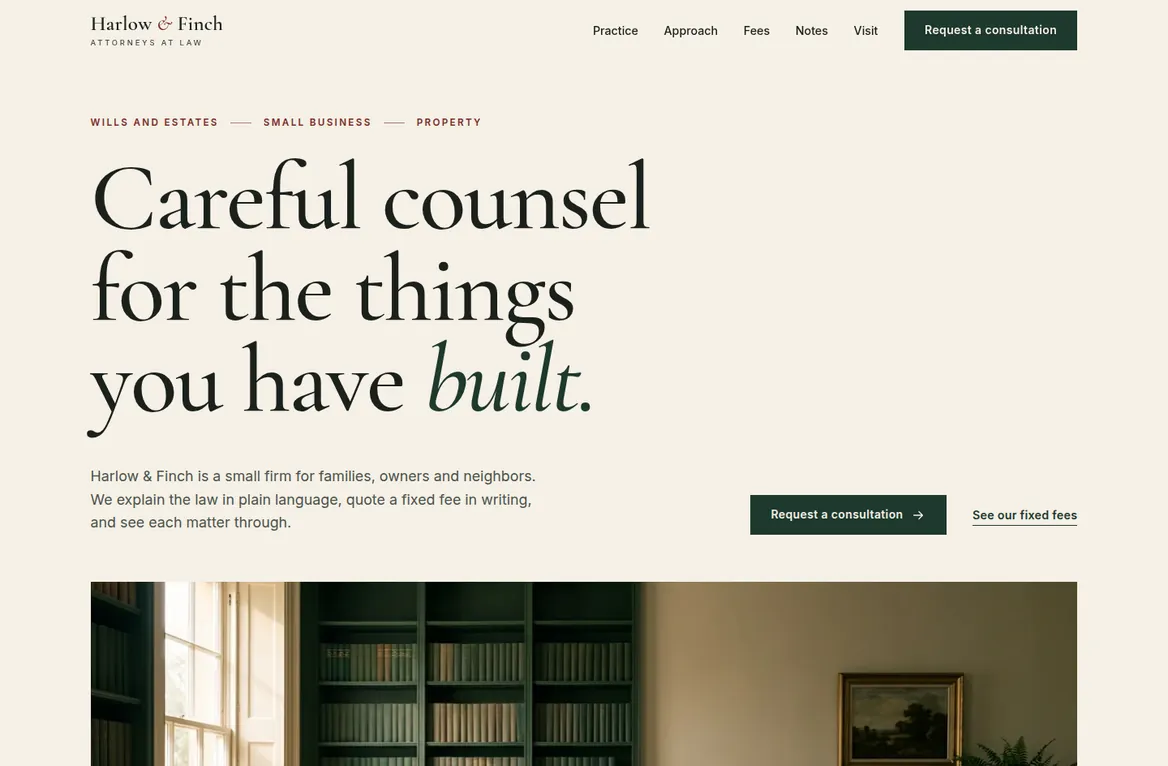
Concept home page for Harlow and Finch, attorneys at law, with a large serif headline and a request a consultation button.
ConceptHarlow and Finch

From your side

What a firm needs from its website.

Written from the side of the firm, because that is where the project starts.

  • We have to look as careful as we are

    A prospective client judges our work by our website before they ever meet us. It should be calm, exact and free of errors, with real names, real credentials and a real office address.

  • Plain language, not jargon

    People arrive worried and unsure what kind of help they need. Each practice area should say in ordinary words what we handle, who it is for and what the first step looks like.

  • Honest answers about fees

    Cost is the question most people are afraid to ask. Where we charge a fixed fee the site should say so, and where we cannot, it should explain how a fee is worked out.

  • A first contact that protects privacy

    A web form is not the place for the facts of a matter. The request should ask only for a name, a way to reach the person and the general kind of help, and leave the rest for a private conversation.

The example

A concept, clearly labeled.

Concept

Harlow and Finch

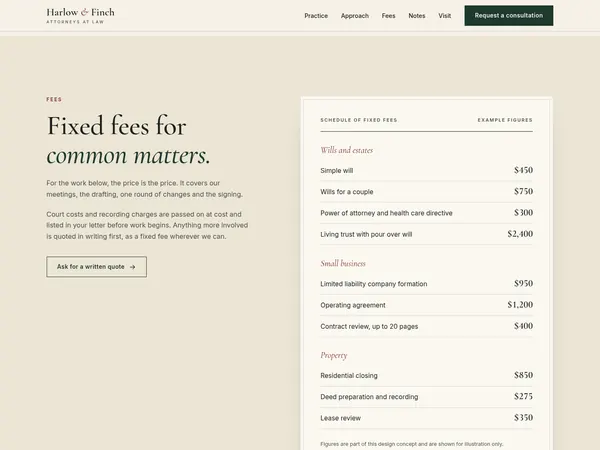
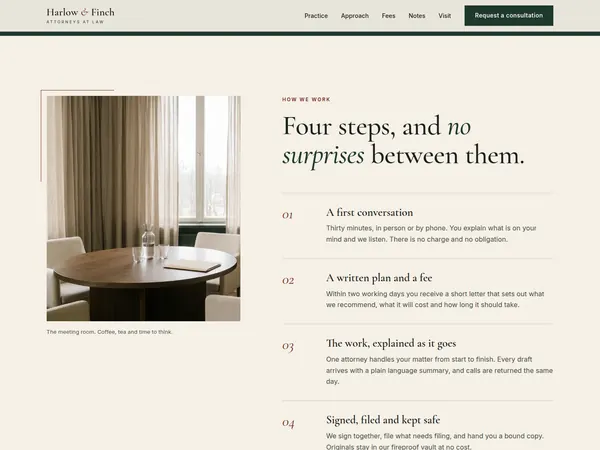
A home page for a small law firm that handles wills and estates, small business and property. It is set in a quiet serif type on cream and deep green, with a request a consultation button in the header, a section that walks through the firm's steps in order, and a table of fixed fees grouped by practice area.

Harlow and Finch is an invented business. We designed and built it to show how we would approach a site in this field. It is not a client.

  • A request a consultation button that stays in the header
  • Three practice areas named above the headline
  • Numbered steps, starting with a first conversation
  • A fixed fee table grouped by practice area, marked as illustration only
See the Harlow and Finch concept
Concept
Harlow and Finch concept how we work section, numbered steps beside a photo of a meeting room.
Harlow and Finch concept fees section, a table of fixed fees grouped under small business and property.Concept

Process

How a project runs.

  1. Talk it through

    A short call about your practice areas, the clients you want to reach and how inquiries are handled today.

  2. Written scope

    Pages, features and the price in writing before any work begins.

  3. Design and review

    You review real pages and approve every word. Any rules your profession sets for advertising are yours to apply, and we build what you sign off on.

  4. Launch and handoff

    Domain connected, forms tested, files delivered and accounts in your name. Care is optional.

Questions

Before you ask.

Have you built a law firm website before?

No, not for a client. Harlow and Finch on this page is a concept, an invented firm that shows how we would lay out a site for a practice. The client sites we have delivered are for childcare and healthcare businesses, and they are on the work page.

What does a website for a firm or practice cost?

Our website packages have published prices. Business Starter is $500 for one scrolling page, and Business Website is $700 for up to five pages. A practice with many practice areas or profiles may need more pages, and each one is written into the scope with its price before work begins. See pricing

What should the consultation form ask for?

As little as possible: a name, a phone number or email address, and the general kind of help. We add a plain note asking people not to include confidential details, and the wording of that note and of any disclaimer is yours to supply and approve. The conversation about the matter itself belongs on the phone or in your office.

Do you know the advertising rules for our profession?

No, and we will not pretend to. We are a web studio, not a legal or regulatory adviser. You tell us what your rules require, such as disclaimers or limits on certain words, and we build the site to match what you approve.

Can you write the practice area pages?

We can draft pages in plain language from the facts you give us, at $100 per page. You review and approve every statement before it is published, because you are the one who knows what is accurate.

Can clients log in, sign documents or pay invoices through the site?

Client portals, document signing and online payment of invoices are larger pieces of work. We have not delivered these for a client yet, so they are scoped and quoted after a call.

How would an AI intake tool fit a practice like ours?

It is optional and separate from the website. An intake tool would organize incoming inquiries for your staff, with a person at the practice reviewing every item. We have not delivered one for a client, so the work is scoped and quoted after a call. Read about AI intake and automation

Who owns the website when it is finished?

The practice does. You hold the domain, and after full payment you receive the agreed custom code and deliverables, subject to any third party licenses. Accounts we set up along the way are opened in your name. Care is optional.

Tell us about your firm.

We will reply with a clear next step and a written scope.

Start a project